Table of Contents
- Why Roof Shingles Matter for Your Home’s Appearance
- Architectural Shingles vs 3-Tab Shingles: Which Improves Curb Appeal
- Best Roof Shingle Colors for a House
- How to Match Roof Shingles with Siding
- Using a Roof Shingle Color Visualizer to Preview Your Choice
- Evaluating Samples in Different Lighting Conditions
- Common Mistakes to Avoid When Choosing Shingles
- Next Steps: Getting Professional Guidance on Your Selection
- Frequently Asked Questions
Last Updated: October 6, 2026
Why Roof Shingles Matter for Your Home’s Appearance
Your roof covers nearly a third of what’s visible from the street, so the right shingles can transform your curb appeal while the wrong choice drags down even a beautiful house.
At DGK Home Solutions, we’ve helped homeowners in Liberty Twp and throughout the Greater Cincinnati area understand that choosing roof shingles isn’t just about protection from the elements. The color, style, and texture set the tone for your siding, trim, gutters, and landscaping, which all need to work in harmony.
Most homeowners treat roof replacement as purely functional, picking whatever the contractor recommends or what’s cheapest. That’s the mistake. Your roof will be visible every day for 15-25 years, so investing time in shingles that complement your home’s architecture and neighborhood pays off in satisfaction and resale value.
Choosing roof shingles doesn’t have to be complicated. With a clear process and honest guidance, you can decide confidently for decades.
Architectural Shingles vs 3-Tab Shingles: Which Improves Curb Appeal
The first decision when learning how to choose roof shingles is understanding the two main styles available: architectural shingles and 3-tab shingles. This choice directly affects your home’s visual impact.
3-tab shingles are the traditional option: flat, uniform, and installed in a regular pattern with one solid color per shingle. On classic, simple homes, especially older ones in historic neighborhoods, they look appropriate and timeless.
Architectural shingles (also called dimensional shingles) use multiple layers to create depth and shadow lines. This texture catches light differently throughout the day, adding visual interest. They cost more upfront but deliver significantly better curb appeal.
Here’s what matters most: architectural shingles make almost every home look more upscale and finished, with a visual richness flat shingles cannot match. If you’re listing your property or want to maximize curb appeal, they’re the stronger choice.
The trade-off is cost and complexity: architectural shingles require more careful installation and cost more than 3-tab. For modern or contemporary homes in Liberty Twp they’re nearly essential; for older colonial or farmhouse styles either works, but architectural still elevates the look.
Architectural shingles hide installation imperfections better than 3-tab shingles. If your roof has any slight irregularities or age-related waviness, the texture of architectural shingles will actually work in your favor by disguising those issues.
Best Roof Shingle Colors for a House
The color of your roof shingles affects how your entire home appears from the street and how it photographs for listings or social media.
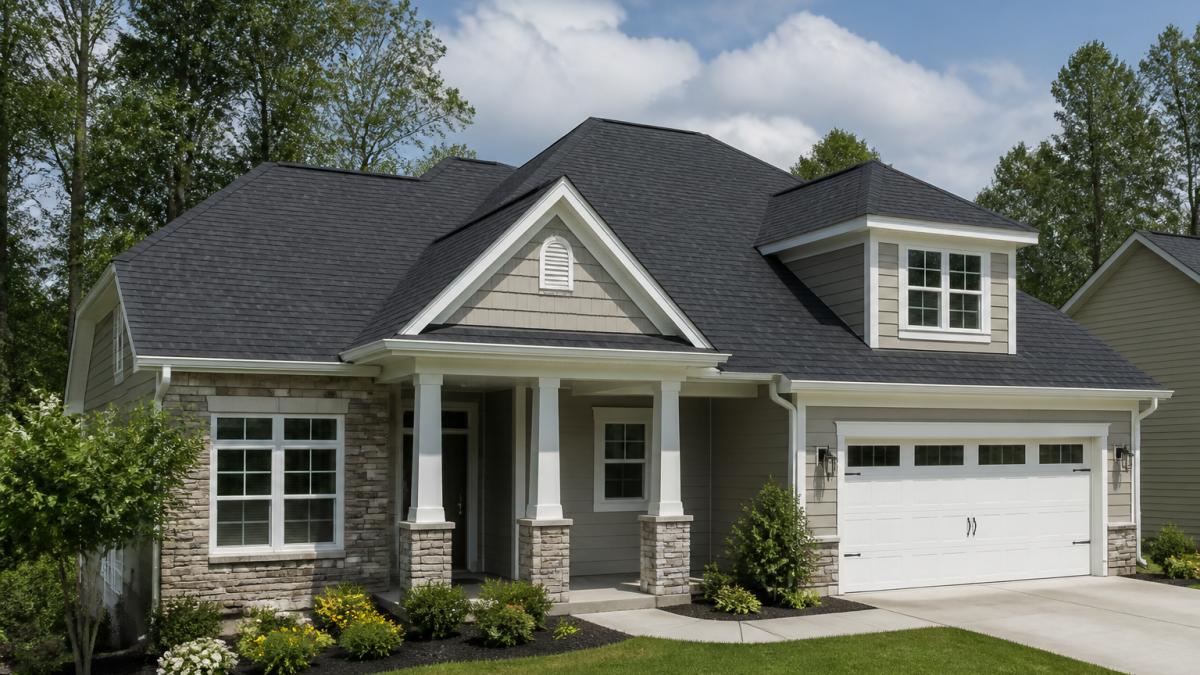
Dark shingles, charcoal gray, dark brown, and black, are most popular for good reason: they hide dirt better than light colors, photograph beautifully, and complement most siding. They create contrast and visual weight that makes homes look more substantial and finished.
Light shingles, tan, light gray, and cream, work best on homes with darker siding and can make a house feel open and airy. However, they show dirt more easily and need more frequent cleaning.
Medium tones, warm grays, soft browns, and blended colors, offer a middle ground. They work with nearly any siding color and don’t show dirt as aggressively as light options, which is why many homeowners find them the “safe” choice, and that’s often the right instinct.
The real secret: your roof shingles should be slightly darker than your siding. This creates visual balance and makes your home look intentional.
Avoid matching your roof color too closely to your siding color. The result looks flat and unfinished. You want your roof and siding to work together, not blend into one another.
How to Match Roof Shingles with Siding
Matching roof shingles with your siding is the key to cohesive curb appeal, and where most homeowners struggle, picking shingles in isolation without considering their home’s existing exterior.
Start by identifying your siding color and material, vinyl, fiber cement, brick, or wood, and its undertone, warm (beige, tan, orange) or cool (gray, blue, white). Then you can make smart shingle choices.
Here’s the process we recommend at DGK Home Solutions:
- Warm siding (tan, beige, cream): Choose warm-toned shingles, dark brown, warm gray, or charcoal with brown undertones. Avoid cool grays and blacks, which will clash.
- Cool siding (white, light gray, blue-gray): Choose cool-toned shingles, charcoal gray, cool black, or slate gray. Warm browns will look out of place.
- Red or orange brick: Dark gray or charcoal shingles create the best contrast. Avoid warm browns that blend too much with the brick.
- Dark siding (dark gray, dark brown, black): You can go darker on the roof or choose a slightly different tone. The key is avoiding an exact match.
The undertone of your shingles matters as much as the shade. “Gray” shingles come in warm and cool versions, and picking the wrong undertone makes your roof look disconnected from your siding even when the shade is correct.
One practical tip: manufacturers often sell sample bundles for under twenty dollars. Buy your top three choices and place them against your siding in different lighting conditions, the most reliable way to ensure a match before committing thousands of dollars in materials.
Using a Roof Shingle Color Visualizer to Preview Your Choice
A roof shingle color visualizer lets you upload a photo of your house and digitally apply different shingle colors and styles before installation.
Many manufacturers offer free visualizer tools on their websites. Upload a photo of your home’s front elevation, select colors and styles from their product line, and the tool shows you what the finished result will look like.
This removes guesswork, since you see colors applied to your actual home with your actual siding and trim, lets you compare options side by side, and gives you something concrete to discuss with your roofing contractor.
The limitation: visualizers show color digitally, and screens display color differently than real materials in natural light. They’re a starting point, not a final decision tool.
After using a visualizer, always evaluate physical samples in different lighting conditions. Digital previews are helpful; real-world testing is essential.
A visualizer helps you narrow your options from dozens to two or three finalists. Then test those finalists with physical samples in actual sunlight before making your final decision.
Evaluating Samples in Different Lighting Conditions
Evaluating shingle samples in different lighting conditions separates confident decisions from regretful ones, showing how your choice will look throughout the day and in various weather.
Daylight changes dramatically: morning light is warm and soft, midday sun is bright and shows colors truest, late afternoon turns golden again, and overcast days wash out color. Each condition makes your shingles appear slightly different.
Here’s how to do this properly:
Get physical samples. Order actual shingle samples, not printed swatches. Real shingles show texture and granule variation that printed materials cannot capture.
Place samples on your roof or against your siding. Don’t evaluate them on your driveway or in your hand.
Evaluate at different times of day. Look at your samples in early morning, midday, and late afternoon light. Notice how the color shifts, and make sure you’re comfortable with all these variations.
Check them on overcast days. Cloudy days reveal how your shingles look without direct sunlight, and many homeowners are surprised by how much their choice changes.
Look from the street. Step back to the curb and view your samples from a distance, the perspective of someone driving or walking past. This is what matters for curb appeal.
A common mistake is evaluating samples in ideal conditions only, bright sunny days with perfect lighting. Real life includes cloudy days, early mornings, and late evenings. Your shingles need to look good in all conditions.
Common Mistakes to Avoid When Choosing Shingles
Most homeowners make predictable mistakes when learning how to choose roof shingles. Recognizing them now saves regret later.
Mistake 1: Picking shingles based on color swatches alone. Printed swatches are notoriously inaccurate. The color you see on paper rarely matches the actual shingle. Always evaluate physical samples in natural light.
Mistake 2: Choosing shingles that match your siding exactly. This creates a flat, unfinished appearance. Your roof should be slightly darker and provide visual contrast to your siding.
Mistake 3: Ignoring neighborhood context. Drive around Liberty Twp and look at homes similar to yours. You don’t need to follow the crowd, but understanding your neighborhood’s aesthetic helps you choose something cohesive with your surroundings.
Mistake 4: Prioritizing cost over appearance. Your roof will be visible for 15-25 years.
Mistake 5: Forgetting about trim and gutters. Your roof color must work with your fascia, soffits, and gutters too, so make sure your shingle choice complements them.
Mistake 6: Making decisions in artificial lighting. Never evaluate samples under indoor or showroom lighting, since fluorescent or LED lights distort color perception. Always evaluate in natural daylight.
Evaluating shingles in a contractor’s office or warehouse under artificial lights is one of the biggest causes of regret. The color will look completely different once installed on your home in natural sunlight.
Next Steps: Getting Professional Guidance on Your Selection
After narrowing your choices and testing samples in natural light, the next step is professional consultation. A qualified roofing contractor brings experience from hundreds of installations and perspective you won’t find online.
When you contact a roofing company, bring your top two or three choices and your samples, and explain what you’re trying to achieve with your curb appeal. A good contractor offers honest feedback, explaining why your choice works or suggesting alternatives.
At DGK Home Solutions, we’ve worked with homeowners throughout Liberty Twp and the Greater Cincinnati area on numerous roof projects.
One thing homeowners often don’t realize: your roofing contractor should be your partner in this decision, not just an order-taker. If a contractor pushes you toward a choice without understanding your goals or dismisses your preferences, that’s a red flag. A professional roofing company wants you to feel confident and satisfied with your selection.
The best time to make this decision is before you’re in crisis mode. If your roof is failing and you need emergency repairs, you’ll have less time to deliberate. If you’re planning ahead, whether for aesthetic reasons or because you know replacement is coming, take the time to make a thoughtful choice now.
Choosing roof shingles for curb appeal is a decision that affects your home’s appearance for decades. Our team has over 20 years of experience helping homeowners in Liberty Twp and beyond achieve the exterior they want while protecting their investment with quality materials and expert installation. Contact us today for a free quote and let’s discuss how to bring your curb appeal vision to life.
Frequently Asked Questions
How do I choose the right roof shingle color for my house?
Start by identifying your home’s dominant exterior color: siding, brick, or stone. Choose shingles that either complement or contrast intentionally with that base color. Neutral tones like charcoal, gray, and brown work with most homes. Pull samples and view them against your actual siding in both morning and afternoon light, since lighting dramatically affects how colors appear. If your home has warm undertones, lean toward warm-toned shingles; cool undertones pair better with cool-toned shingles.
What’s the difference between architectural shingles and 3-tab shingles for curb appeal?
Architectural shingles have a dimensional, layered appearance that creates shadow lines and texture, making your roof look more visually interesting and upscale. Three-tab shingles are flat and uniform, offering a cleaner, simpler look. Architectural shingles generally boost curb appeal more noticeably because they add depth and character to your roofline. However, 3-tab shingles can look perfectly attractive on certain home styles, especially ranch or cottage designs where simplicity is appropriate.
Should roof shingles be lighter or darker than my siding?
There’s no single rule, it depends on your home’s style and the effect you want. Lighter shingles on darker siding create high contrast and draw attention upward, making the roof a focal point. Darker shingles on lighter siding create a grounded, balanced appearance. The key is ensuring the two colors don’t clash. Pull actual samples of both your siding and potential shingle colors and view them together in natural light before deciding.
How can I preview roof shingle colors on my home before ordering?
Use a roof shingle color visualizer tool online to upload a photo of your home and digitally apply different shingle colors. Many manufacturers offer these tools on their websites. However, digital previews can be inaccurate due to lighting and screen settings. Always order physical samples from your roofing contractor, hold them against your actual siding in both daylight and shade, and view them from different angles. This real-world approach is far more reliable than digital previews alone.