Table of Contents
- Understanding Siding Materials for Historic Homes
- Historic Preservation Siding Guidelines and Regulatory Requirements
- Traditional Wood Siding: Restoring Historic Wood Siding
- Fiber Cement Siding for Historic Homes
- Synthetic Alternatives: Vinyl, Composite, and Engineered Wood
- Cost of Siding for Historic Homes: Budget Planning and ROI
- Siding Profile Comparison: Clapboard, Beaded, and Shingle
- Choosing the Right Siding Material for Your Historic Property
Siding Materials for Historic Homes: A Preservationist’s Guide
Last Updated: July 29, 2026
When restoring a historic home’s exterior, selecting the right siding material is critical. The wrong choice can compromise both historical integrity and structural performance. At DGK Home Solutions, we’ve guided countless property owners through historic restoration projects across the Greater Cincinnati area, learning that material selection involves understanding how different options interact with moisture, weather, building codes, and your home’s architectural era.
This guide covers traditional wood siding, modern fiber cement and composite alternatives, regulatory requirements, and the trade-offs between authenticity and practicality.
Understanding Siding Materials for Historic Homes
Historic homes were built with materials designed to breathe, moisture could move through and evaporate. Modern synthetic sidings, particularly vinyl, can trap moisture behind exterior walls, leading to rot, mold, and structural damage that may take years to appear. Understanding the building envelope is critical.
The most common mistake homeowners make is choosing siding based on appearance alone. A beautiful material that traps moisture will cost far more in repairs than a slightly less authentic option that manages water properly.
Historic preservation uses modern building science to protect existing structures while respecting their origins. The National Park Service publishes preservation briefs addressing this tension, with guidance that has evolved as we’ve learned more about moisture management in older structures.
Historic Preservation Siding Guidelines and Regulatory Requirements
Before ordering siding, understand what your local historic district will allow. Standards vary dramatically by jurisdiction, some allow fiber cement and composites matching original profiles, others demand authentic wood, and a few approve carefully selected vinyl products.
The National Park Service Preservation Brief 16 provides widely referenced guidance on selecting siding for historic buildings. It identifies wood as the preferred choice but recognizes fiber cement as acceptable when wood isn’t feasible, provided it replicates the original profile, exposure width, and finish.
Your local historic district commission will review plans before work begins. Working with your commission early usually smooths the process, they want you to succeed.
Tax Credits and Grant Eligibility for Authentic Restoration
If your home qualifies as a historic property under the National Register of Historic Places, you may be eligible for the federal historic preservation tax credit, covering 20% of qualified rehabilitation expenses for income-producing buildings and 10% for residential properties.
The requirement: use materials and methods consistent with your property’s historic character. Authentic wood siding generally qualifies; vinyl does not. Fiber cement eligibility depends on your specific project.
The 20% federal tax credit can offset the premium for authentic materials. On a $50,000 siding project, that’s $10,000 back. Run the numbers before dismissing expensive options.
Many states and municipalities offer additional grants or low-interest loans. Ohio administers preservation grants through the Ohio History Connection, often with specific material and method requirements.
Traditional Wood Siding: Restoring Historic Wood Siding
Wood siding remains the gold standard for historic homes. It’s the original material, manages moisture correctly, can be repaired in sections, and lasts generations when properly maintained. The challenge is that it requires genuine expertise and ongoing care.
Clapboard, Cedar Shake, and Authentic Profiles
Clapboard siding comes in different profiles and widths by era. A 1910 Craftsman bungalow might have 5-inch clapboard, while an 1880s Victorian could have 6-8 inch boards. Cedar shake, common on Colonial Revival homes, has a different visual character with visible grain and knots.
Getting the profile right matters significantly. When replacing siding, you’re choosing whether to honor or alter your home’s architectural identity. Davis-Hawn Historical Wood Siding specializes in sourcing and milling authentic profiles for historic restoration.
Reclaimed Lumber and Custom Molding Patterns
Some homeowners pursue reclaimed siding salvaged from other historic buildings, offering authenticity reproduction materials can’t match. Reclaimed siding typically costs two to three times more than reproduction material but offers genuine age and character. Work with a salvage specialist who understands historic materials and can inspect for hidden damage, pest infestation, or contamination.
Maintenance Requirements and Paint Adhesion
Wood siding demands inspection every 5-10 years for damage, reapplication of paint or sealant, and immediate attention to rot or pest damage. Lead paint is another consideration. If your home was painted before 1978, the original paint likely contains lead. Have your existing siding tested for lead before beginning work and budget for proper lead remediation using EPA-certified contractors.
Ignoring wood siding maintenance turns manageable upkeep into expensive structural damage. A single missed season can allow water penetration requiring years and thousands of dollars to repair.
Fiber Cement Siding for Historic Homes
Fiber cement has become the preferred alternative to wood for many historic homeowners and preservation professionals. It’s durable, low-maintenance, and can replicate wood siding convincingly enough to satisfy most historic commissions.
James Hardie is the market leader in fiber cement siding. Their products resist weather, moisture, fire, and pests, with ColorPlus technology including a 15-year warranty against chips or finish damage. James Hardie fiber cement siding is recognized in NPS Preservation Brief 16 as an acceptable substitute for wood in historic preservation projects.
Why Fiber Cement Matches Historic Aesthetics
Fiber cement can be manufactured to match authentic profiles, offering lap siding, shingles, and vertical boards replicating wood styles. When properly selected, finishes don’t have the plastic appearance vinyl sometimes carries. From the curb, it reads as authentic siding, which is why many historic commissions accept fiber cement as a reasonable compromise when wood isn’t feasible.
Nichiha’s VintageWood fiber cement panels offer finely embossed grain mimicking natural wood with remarkable precision, representing the premium option for homeowners wanting fiber cement’s durability without visual compromise.
Durability, Moisture Barriers, and Long-Term Performance
Fiber cement’s real advantage is durability. Properly installed fiber cement outlasts wood by decades. It won’t rot, won’t be damaged by insects, and won’t require repainting every 5-10 years.
Fiber cement performs best with a proper moisture barrier and ventilated rainscreen system, allowing moisture behind the siding to escape rather than accumulate. Installation requires special tools and expertise not every contractor possesses. The tradeoff: fiber cement costs more than vinyl but less than high-end wood restoration.
Synthetic Alternatives: Vinyl, Composite, and Engineered Wood
The synthetic siding market offers new products claiming to solve every problem wood and fiber cement present. Some work well for historic homes; others are fundamentally incompatible with preservation goals.
Vinyl Siding: Affordability vs. Preservation Concerns
Vinyl is the most affordable option and genuinely low-maintenance. CertainTeed’s Monogram vinyl uses TrueTexture technology to replicate wood convincingly, while Alside’s Charter Oak Premium Vinyl is a Consumer Reports "Best Buy" with strong wind resistance and color stability.
However, vinyl has a moisture problem in historic homes. Vinyl doesn’t breathe. When water gets behind vinyl siding, it accumulates, promoting rot in underlying framing and sheathing. This is particularly problematic in older homes with solid wood sheathing and no vapor barriers. Many historic preservation professionals view vinyl as incompatible with historic homes regardless of aesthetics.
Vinyl works fine for modern homes with vapor barriers and proper ventilation. For historic homes with original construction, fiber cement or wood is usually the safer choice from a building science perspective.
Composite and Advanced Materials for Historic Profiles
Composite siding like Everlast Advanced Composite and Alside Ascend offers a middle ground, combining durability with better moisture management than vinyl. Everlast composite is made from natural polymeric resins and inorganic minerals with UV-stable acrylic capstock, never needing painting and coming with a lifetime warranty.
LP SmartSide engineered wood combines wood aesthetics with enhanced durability through their SmartGuard process, resisting fungal decay and termites. It costs more than vinyl but less than solid wood or fiber cement, with significantly lower maintenance than traditional wood.
Cost of Siding for Historic Homes: Budget Planning and ROI
Siding costs vary by material, profile, installation complexity, and location. For historic homes, labor often runs higher due to complexity, unusual roof angles, custom profiles, lead paint remediation, and specialized contractors all add costs.
Material Costs vs. Installation Complexity
Installed siding costs typically break into material (30-40%) and labor (60-70%). Vinyl siding runs roughly $4.50-$9.00 per square foot installed. Fiber cement runs $10-$22+ per square foot. Composite materials fall in between. Engineered wood like LP SmartSide runs $5.50-$10.50 per square foot.
For a 2,000-square-foot home exterior, that’s the difference between $9,000-$18,000 for vinyl versus $20,000-$44,000 for fiber cement. The federal tax credit can offset 20% of qualified expenses.
Lead Paint Remediation and Hidden Expenses
If your home was painted before 1978, assume the original paint contains lead. EPA regulations require certified lead abatement contractors for renovation work, adding $2,000-$5,000 depending on scope.
Budget additionally for removal of old siding ($1-$3 per square foot), repair of damaged sheathing or framing ($50-$100 per square foot for affected areas), installation of new sheathing or moisture barriers ($1-$3 per square foot), and permits and inspections (5-10% of material costs). These hidden costs often surprise homeowners, turning a $15,000 material project into $25,000 once everything is factored in.
Siding Profile Comparison: Clapboard, Beaded, and Shingle
Historic siding profiles are far more diverse than modern homeowners often realize. Understanding differences helps you make authentic choices and communicate clearly with contractors.
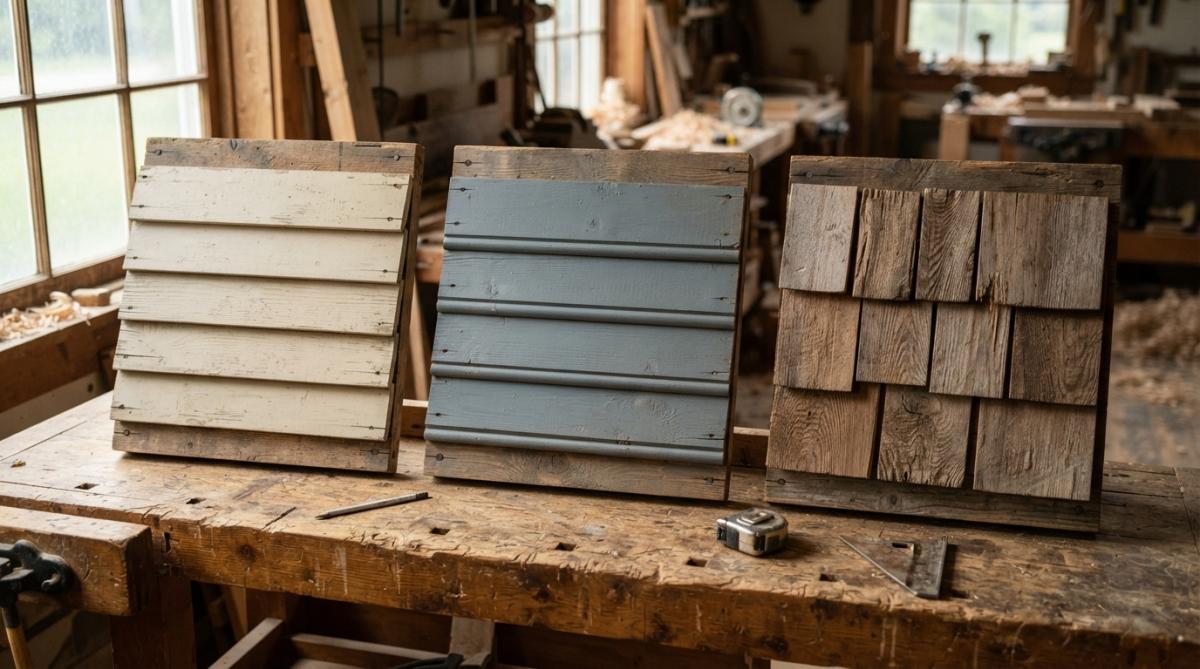
Visual Differences and Historical Accuracy
Clapboard is the most common historic profile, simple overlapping horizontal planks with beveled edges creating shadow lines that give visual depth. Widths typically range 5-8 inches and vary by era.
Beaded siding has a distinctive rounded bead along the bottom edge, popular in the late 1800s and early 1900s on Victorian and Craftsman homes, creating a more decorative appearance than plain clapboard.
Cedar shake and shingles are thicker, textured materials with visible grain and knots, common on Colonial Revival homes, Craftsman cottages, and high-end Victorian properties.
Drop siding features a distinctive profile with a notch or groove at the bottom, creating an interlocking appearance, popular in the early 1900s.
Matching Profiles to Your Home’s Era and Style
Getting the profile right requires research. Look at original photographs if they exist and examine neighboring homes of the same era and style. Consult your local historic commission or a preservation architect. When sourcing reproduction materials, insist on samples to see how the profile catches light and how paint finishes look.
Choosing the Right Siding Material for Your Historic Property
Your decision depends on several factors: your commitment to authenticity, your maintenance tolerance, your budget, your local regulations, and your building’s specific characteristics. Homes with solid wood sheathing and no vapor barriers need materials managing moisture differently than modern construction. Have a preservation architect or experienced contractor assess your situation.
Working with Historic Commissions and Preservation Boards
If you’re in a historic district, your relationship with the local historic commission determines what’s possible. Schedule a pre-application meeting with photographs, documentation of original siding profiles if available, and material samples. Many homeowners find that working collaboratively with their historic commission results in better outcomes than fighting the process.
DGK Home Solutions has worked extensively with historic properties across the Greater Cincinnati area and understands the regulatory landscape. When ready to move forward with your siding project, we can help you navigate the approval process while ensuring your home is protected with quality materials and expert installation.
Restoring siding on a historic home is one of the most visible decisions you’ll make as a property owner. It affects curb appeal, structural integrity, and long-term maintenance costs. Your material choice should reflect both your home’s historical character and your realistic ability to maintain it over time. DGK Home Solutions provides expert siding installation with honest assessment of your property’s needs and craftsmanship to protect your historic home properly. Ready to get started? Get a FREE QUOTE and let our team help you choose the right siding material for your historic property.
Frequently Asked Questions
What siding materials are approved by historic preservation commissions?
Most historic commissions approve fiber cement siding (especially James Hardie), authentic reclaimed wood, and engineered wood products like LP SmartSide when they match original profiles. Vinyl siding is often discouraged because it can trap moisture and lacks the architectural authenticity of wood or fiber cement. Always check your local historic district guidelines, approval depends on your home's era, style, and whether the material can replicate the original appearance, including proper clapboard width, molding patterns, and paint adhesion characteristics.
How do I restore historic wood siding without losing authenticity?
Authentic restoration involves cleaning and repainting existing clapboard or cedar shake rather than replacing it. If replacement is necessary, source reclaimed lumber or custom-milled wood matching the original profile, thickness, and wood species. Work with specialists like Davis-Hawn who source historically accurate materials and understand molding patterns. Proper maintenance, regular caulking, paint touch-ups, and wood preservative application, extends the life of original siding. For homes in historic districts, document your restoration work to qualify for tax credits.
Is fiber cement siding appropriate for historic homes?
Yes, fiber cement siding is widely accepted for historic homes and is specifically endorsed in the National Park Service Preservation Brief 16. It replicates wood appearance convincingly, resists rot and pests, and requires less maintenance than wood. Fiber cement can be manufactured in authentic profiles like clapboard and beaded siding. However, ensure the product matches your home's original board width and profile. James Hardie and Nichiha both offer historically appropriate options. Installation costs are higher than vinyl but justified by durability and preservation board approval.
What's included in the cost of siding for historic homes?
Siding costs vary significantly based on material choice. Fiber cement typically ranges higher than vinyl due to durability and authenticity. Budget for lead paint remediation if your home was built before 1978, this adds substantial expense and requires EPA-certified contractors. Installation complexity increases with historic profiles and existing building conditions. Reclaimed wood and custom-milled options cost more than standard materials. Get a comprehensive quote that includes sheathing repair, moisture barriers, tar paper replacement, and any building code upgrades. DGK Home Solutions provides honest assessments of hidden costs before work begins.
Can I use vinyl siding on a historic home?
Vinyl siding is generally discouraged for historic homes, particularly in historic districts. While affordable and low-maintenance, vinyl can trap moisture against the building envelope, leading to wood rot and structural damage, a serious concern for older homes. Many preservation boards reject vinyl because it doesn't replicate authentic profiles accurately and can melt under intense heat. If budget is a primary concern, engineered wood or fiber cement offer better balance of affordability, authenticity, and moisture management than vinyl for historic properties.
This article was written using GrandRanker