Table of Contents
- Best Siding Materials for Resale Value 2026: Quick Comparison
- 1. Fiber Cement Siding: Premium Durability & Resale Appeal
- 2. Engineered Wood Siding: Realistic Aesthetics with Low Maintenance
- 3. Vinyl Siding: Budget-Friendly Option with Solid ROI
- 4. Stone Veneer: High-Impact Curb Appeal for Premium Markets
- 5. Metal Siding: Fire Resistance & Extreme Durability
- How Siding Affects Home Resale Value: What Buyers Actually Notice
- Siding ROI 2026: What You’ll Actually Recover at Resale
Best Siding for Resale Value 2026: Top Materials Ranked
Last Updated: July 28, 2026
When homeowners invest in siding replacement, they’re asking one critical question: will this actually pay off when I sell? Finding the best siding for resale value 2026 requires understanding how different materials impact buyer perception, home appraisals, and long-term durability. At DGK Home Solutions, we’ve spent over 20 years helping homeowners navigate exterior upgrades that genuinely move the needle on property value. This guide covers the siding materials that consistently deliver strong returns, the regional preferences that matter, and the honest limitations of each option.
Best Siding Materials for Resale Value 2026: Quick Comparison
When evaluating siding for resale value, three factors dominate buyer behavior: curb appeal on first viewing, perceived durability and longevity, and the absence of visible damage or wear. Fiber cement consistently ranks highest among real estate professionals and appraisers for its premium aesthetic combined with genuine longevity. Engineered wood siding offers authentic wood appearance without the maintenance burden that scares away buyers. Vinyl remains the budget-friendly workhorse, delivering solid ROI for modest investments. Stone veneer commands attention in higher-end markets. Metal siding appeals to specific buyers in fire-prone regions and modern design-forward markets.
| Material | Typical Lifespan | Maintenance Level | Resale Appeal | Best For Markets |
|---|---|---|---|---|
| Fiber Cement | 30-50+ years | Low | Excellent | Coastal, high-value homes |
| Engineered Wood | 20-30 years | Medium | Very Good | Suburban, traditional homes |
| Vinyl | 20-30 years | Very Low | Good | Budget-conscious buyers |
| Stone Veneer | 50+ years | Low | Excellent | Premium/upscale markets |
| Metal | 40-70 years | Very Low | Good | Fire zones, modern homes |
1. Fiber Cement Siding: Premium Durability & Resale Appeal
Fiber cement siding, particularly James Hardie products, stands out as the single best choice for maximizing resale value in most U.S. markets. This material combines the aesthetic authenticity of wood with fire resistance, pest resistance, and a lifespan exceeding 40 years. Home appraisers and real estate agents consistently cite fiber cement as a premium upgrade that signals quality and long-term thinking to potential buyers.
Buyers see deep wood-grain textures that look authentic, colors that don’t fade thanks to ColorPlus Technology, and a material that resists rot, termite damage, and weather degradation. In coastal regions and high-value markets, fiber cement has become the default expectation for homes above a certain price point.
Installation requires skilled labor, fiber cement is heavy and brittle before installation, demanding specialized tools and training. DGK Home Solutions brings over 20 years of experience installing fiber cement correctly, ensuring proper fastening, flashing, and paint application so the material performs as designed.
The HardieZone System tailors fiber cement formulations to different climates: coastal salt spray zones, freeze-thaw regions, and dry climates each receive engineered products. This regional specificity ensures optimal performance when matched to your climate.
Fiber cement costs more upfront than vinyl or engineered wood. Installation runs $7-$18 per square foot depending on your region and home complexity. For a 2,500 square foot exterior, expect $17,500 to $45,000 for materials and labor. However, the resale value recovery in premium markets often justifies this investment.
If you’re in a fire-prone region (California, Colorado, Arizona), fiber cement’s non-combustible rating can lower your insurance premiums by 10-15% annually, offsetting some of the upfront cost difference versus vinyl.
2. Engineered Wood Siding: Realistic Aesthetics with Low Maintenance
Engineered wood siding splits the difference between authentic wood appearance and practical durability. Products like LP SmartSide and Diamond Kote use treated wood strands bonded with resins and waxes, creating a material that resists fungal decay, termites, and moisture while maintaining the warm, natural look that buyers prefer to vinyl’s plastic appearance.
The resale value advantage of engineered wood over vinyl is subtle but real. Buyers perceive engineered wood as "real" material with genuine character. Diamond Kote represents the premium engineered wood option, with a factory-applied finish and 30-year no-fade warranty that eliminates on-site painting and ensures color consistency.
Impact resistance matters significantly. Engineered wood products like LP SmartSide demonstrate superior impact resistance compared to vinyl, which can crack or dent from modest impacts. In hail-prone regions, this durability advantage translates to visible appeal at resale time.
Installation costs typically run $4.50-$14.00 per square foot installed, positioning engineered wood between vinyl and fiber cement.
Engineered wood requires careful installation to prevent water intrusion at seams, corners, and penetrations. Improper flashing or caulking can allow moisture behind the siding, leading to rot and structural damage that devastates resale value. Hire experienced installers who understand water management.
3. Vinyl Siding: Budget-Friendly Option with Solid ROI
Vinyl siding delivers surprising resale value for its modest cost. While it ranks below fiber cement and engineered wood in buyer perception, vinyl’s low maintenance, durability improvements over the past decade, and vast color/style options make it a rational choice for homeowners on tighter budgets or in markets where premium materials don’t command price premiums.
Modern vinyl products like Alside Charter Oak with TriBeam reinforcement and Ply Gem Mastic Quest offer authentic wood-grain textures and color stability that early vinyl couldn’t match. Lifetime fade warranties on premium vinyl lines signal durability to buyers.
The resale value recovery from vinyl is straightforward: it typically recovers 70-85% of installation costs through increased appraisal value and buyer appeal. For a $12,000 vinyl siding project, expect $8,400-$10,200 back in resale value.
Vinyl’s weakness is visible wear over time. Fading, chalking, and brittleness in cold climates reduce perceived quality compared to materials that maintain their appearance for decades. In markets where homes regularly sell for $300,000+, buyers increasingly expect premium siding materials.
Installation costs run $5.00-$7.50 per square foot installed, making vinyl the most accessible option for most homeowners.
Vinyl’s real advantage isn’t premium resale appeal, it’s accessibility. You can upgrade your home’s exterior for a reasonable investment, improve curb appeal immediately, and recover most of your cost at sale time.
4. Stone Veneer: High-Impact Curb Appeal for Premium Markets
Stone veneer creates dramatic curb appeal that commands attention. Unlike full stone masonry, manufactured stone veneer like Boral Versetta Stone installs with a mortarless system using standard carpentry tools, making it accessible to more contractors.
The resale value impact of stone veneer is highly market-dependent. In upscale neighborhoods where stone is common and expected, it delivers excellent returns. In modest suburban markets, stone veneer can look out of place and actually reduce perceived value. Market alignment is critical.
Pricing runs $18-$38 per square foot installed. For a 2,500 square foot home, expect $45,000-$95,000 for a complete stone veneer exterior. This investment only makes sense if your market supports it, typically homes selling for $400,000 or higher in established upscale neighborhoods.
Stone veneer’s durability is excellent. The fiber-reinforced concrete substrate resists freezing and thawing cycles, and the material maintains its appearance for 50+ years with minimal maintenance.
5. Metal Siding: Fire Resistance & Extreme Durability
Metal siding, primarily steel with factory-applied finishes, appeals to specific market segments and geographic regions. In fire-prone areas (California, Colorado, Arizona), metal’s non-combustible rating makes it a practical choice that can lower insurance costs. In modern design-forward neighborhoods, corrugated or standing-seam metal creates distinctive contemporary aesthetics.
Products like BarrierBoss offer 26-gauge steel with durable finishes and 40-year warranties. The material withstands extreme weather, resists pests entirely, and requires virtually no maintenance. Lifespan often exceeds 40-70 years, rivaling fiber cement.
Resale value recovery depends heavily on market positioning. In fire zones where metal is common, it performs well. In traditional suburban markets, metal siding can appear industrial or unconventional, potentially limiting buyer interest.
Pricing ranges $4.50-$15.00 per square foot installed, positioning metal competitively with engineered wood while offering superior durability.
How Siding Affects Home Resale Value: What Buyers Actually Notice
Siding impacts resale value through three distinct mechanisms: immediate curb appeal during showings, perceived durability and long-term maintenance burden, and the tangible condition of the material itself.
Curb Appeal & First Impressions
Buyers form opinions about a home within 7-10 seconds of pulling up. Siding color, material texture, and visible condition dominate this first impression. Neutral colors like warm white, greige, light gray, and soft taupe appeal to the broadest buyer base. These colors signal cleanliness, modernity, and neutrality, allowing buyers to imagine their own style in the space.
Bold siding colors or trendy shades can reduce resale value by limiting the buyer pool. Visible damage, cracks, dents, discoloration, mold, or deterioration immediately signals to buyers that the home hasn’t been maintained, directly impacting appraisal value and negotiating power.
Energy Efficiency & Long-Term Savings
Modern siding materials work with insulation systems to improve thermal performance. Fiber cement and engineered wood siding can be installed with continuous insulation layers that reduce heating and cooling costs. Homes with modern, energy-efficient siding systems command modest appraisal premiums, typically 2-5% depending on local energy costs.
Durability & Structural Integrity
Buyers and appraisers evaluate siding as a proxy for overall home maintenance. Quality siding that resists weather, pests, and deterioration signals that the home has been cared for. Material longevity directly impacts perceived value. Fiber cement’s 40-50 year lifespan signals permanence and quality. Vinyl’s 20-30 year lifespan is acceptable but suggests future replacement costs.
Siding ROI 2026: What You’ll Actually Recover at Resale
Return on investment for siding varies significantly by material, market, and home value. Premium materials in premium markets deliver strong ROI; premium materials in modest markets deliver moderate ROI; budget materials in any market deliver solid but unspectacular ROI.
Material-by-Material ROI Breakdown
Fiber Cement Siding: In coastal regions and homes valued above $300,000, fiber cement typically delivers 80-100% cost recovery at resale. In modest suburban markets, recovery drops to 60-75%.
Engineered Wood Siding: Engineered wood typically recovers 70-85% of installation costs across most markets.
Vinyl Siding: Vinyl recovers 70-85% in most markets, with slightly higher recovery in budget-conscious suburban areas.
Stone Veneer: Stone veneer recovers 60-80% in premium markets where it’s expected; 30-50% in markets where it appears incongruous.
Metal Siding: Metal recovers 70-85% in fire-prone regions and modern design neighborhoods; 50-70% in traditional markets.
The best siding for resale value 2026 isn’t always the most expensive option. It’s the material that matches your market’s expectations and your home’s price point. A $15,000 fiber cement upgrade on a $150,000 home delivers poor ROI because buyers in that market expect vinyl or engineered wood. The same upgrade on a $400,000 home delivers excellent ROI.
Long-Term Cost of Ownership Beyond Initial Investment
Fiber cement requires minimal maintenance but costs more to repair if damage occurs. Over 40 years, expect occasional repairs but relatively low total maintenance cost.
Engineered wood requires periodic inspection and caulking maintenance to prevent water intrusion. Estimated maintenance cost: $500-$1,500 over 20-30 years.
Vinyl requires virtually no maintenance beyond occasional cleaning. However, fading and brittleness occur around year 20-25, necessitating full replacement.
Stone veneer requires minimal maintenance but repairs are expensive and specialized. Estimated maintenance: $1,000-$3,000 over 50 years.
Metal requires virtually no maintenance. Finishes hold up for 40+ years.
When you factor in maintenance costs plus eventual replacement, fiber cement and metal emerge as the most cost-effective long-term choices despite higher upfront costs.
Siding Trends for 2026: Colors & Styles That Boost Buyer Interest
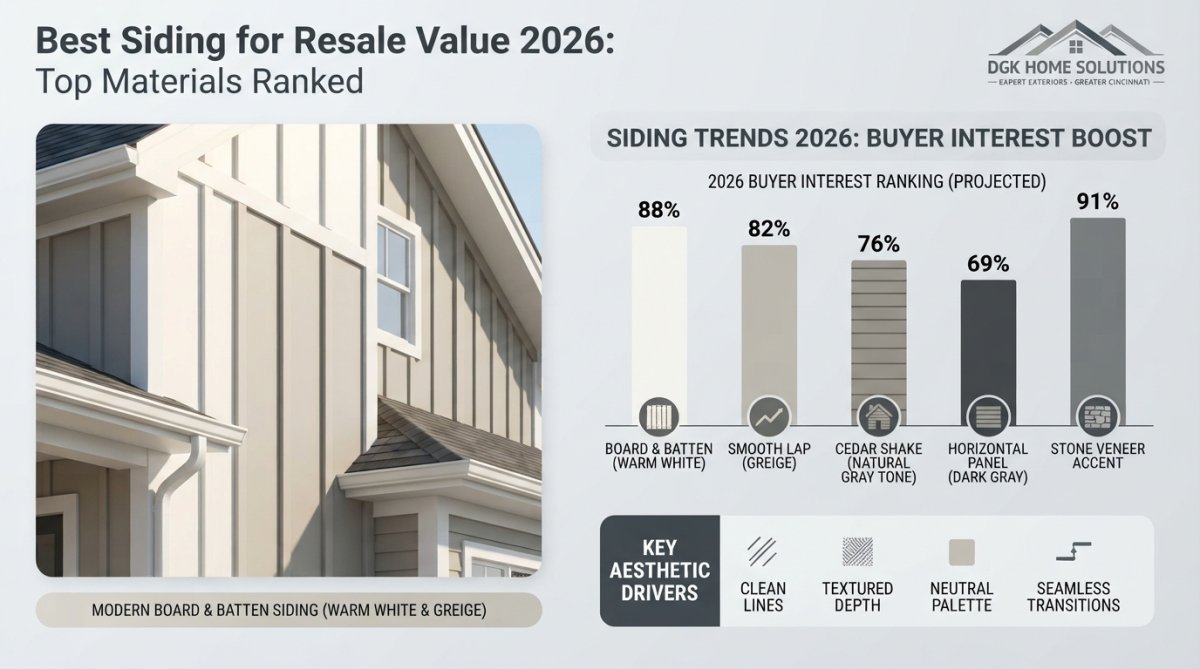
Warm whites and creamy off-whites remain popular, but greige, a sophisticated blend of gray and beige, has become the dominant choice among new construction and premium renovations. Light gray and soft taupe also appeal broadly.
Board and batten profiles (vertical boards with accent strips) continue gaining popularity, particularly on engineered wood and fiber cement. This style signals contemporary design awareness while maintaining traditional appeal.
Shake siding profiles, mimicking wood shakes or shingles, appeal to traditional and coastal markets. Darker siding colors have emerged in modern design neighborhoods, particularly charcoal gray and deep taupe, though these reduce resale appeal in traditional markets.
The trend toward mixed materials, combining siding with stone veneer accents, metal panels, or board and batten trim, continues. This approach adds visual interest and signals design intentionality.
Key Factors When Choosing Siding for Resale Value
Climate fundamentally shapes siding performance and buyer expectations. Coastal regions favor fiber cement for salt spray resistance. Freeze-thaw zones require materials that won’t crack from ice expansion. Hot, dry climates benefit from light colors and materials that resist sun damage. Fire-prone regions increasingly expect fire-resistant materials.
Neighborhood aesthetic expectations matter more than personal preferences. Evaluate what siding materials dominate your neighborhood. If 80% of homes have fiber cement, upgrading to fiber cement signals quality.
Budget constraints are real. Premium materials deliver better ROI but require larger upfront investment. Choose materials that align with buyer expectations at your home’s price level.
Installation quality determines whether siding performs as designed. A poorly installed premium material delivers worse results than properly installed budget material. DGK Home Solutions’ 20+ years of experience ensures correct installation, proper flashing, appropriate fastening, and attention to detail that makes the material perform as engineered.
Maintenance tolerance varies by material. If you prefer zero maintenance, vinyl or metal makes sense. If you’re willing to maintain materials properly, engineered wood or fiber cement offer superior long-term value.
Choosing new siding is one of the most visible exterior upgrades you can make, and it directly impacts how potential buyers perceive your home’s quality and condition. The best siding for resale value 2026 depends on your climate, neighborhood expectations, budget, and long-term ownership plans. DGK Home Solutions brings two decades of experience installing premium siding materials correctly, ensuring proper flashing, appropriate fastening, and finishes that perform as designed. Our stress-free process, honest assessment of your home’s needs, and prompt communication mean you’ll understand exactly what you’re getting and why it matters for your home’s resale value. Get a free quote today and discover which siding material makes sense for your specific situation and market.
Frequently Asked Questions
What siding material has the best return on investment for resale value in 2026?
Fiber cement siding consistently delivers strong ROI due to its exceptional durability (30-50+ years), superior curb appeal, and fire resistance. Engineered wood and vinyl also offer solid returns, though fiber cement commands premium pricing from buyers seeking low-maintenance, long-lasting exteriors. ROI varies by region and local buyer preferences, so consult local appraisers or real estate agents for your specific market.
How much value does fiber cement siding add to a home?
Fiber cement siding typically recovers 70-80% of installation costs at resale, higher than many exterior upgrades. Its appeal lies in durability, weather resistance, and minimal maintenance, factors that resonate with buyers in competitive markets. However, exact value depends on your home's location, condition, and buyer demographics. A professional appraisal can quantify the impact for your property.
Is low maintenance siding for resale worth the investment?
Yes. Low-maintenance materials like fiber cement, engineered wood with pre-finished coatings, and premium vinyl reduce buyer concerns about future repairs and upkeep. Homes with minimal exterior maintenance needs appeal to busy professionals and retirees, expanding your buyer pool. The upfront cost is often offset by faster sales and higher offers in markets where maintenance burden is a deal-breaker.
What siding colors are trending for resale value in 2026?
Neutral, warm tones dominate: warm white, greige, light gray, and soft taupe. These colors appeal to broad buyer demographics, complement modern and traditional architecture, and age well without appearing dated. Bold or trendy colors may limit buyer appeal, even if they look attractive today. Neutral siding paired with colorful trim or landscaping offers visual interest without narrowing your market.
Does new siding increase home value enough to justify the cost?
New siding increases appraisal value and buyer perception of curb appeal and structural integrity. Recovery rates range from 50-80% depending on material and market. Beyond resale value, new siding improves energy efficiency, reduces maintenance costs, and may lower insurance premiums. For long-term homeowners, the combination of resale gains, utility savings, and reduced upkeep justifies the investment.
This article was written using GrandRanker