Table of Contents
- Why Clogged Gutters Threaten Commercial Roofs
- Commercial Gutter Cleaning Frequency: How Often Is Enough?
- OSHA Gutter Cleaning Safety Standards You Must Follow
- Commercial Gutter Cleaning Tools and What You’ll Need
- Step-by-Step: How to Clean Commercial Roof Gutters
- Common Mistakes to Avoid When Cleaning Commercial Gutters
- When to Call a Professional Gutter Cleaning Service
- Frequently Asked Questions
Last Updated: September 5, 2026
Why Clogged Gutters Threaten Commercial Roofs
Water is the single greatest enemy of a commercial roof, and clogged gutters are the most direct path to water damage. When gutters fill with leaves, gravel, and debris, rainwater backs up under the roof edge, saturating the fascia, decking, and even interior walls. This guide covers the full process of how to clean commercial roof gutters safely and effectively, whether you manage a retail strip in Liberty Twp or an office complex in Cincinnati.
The financial argument for staying ahead of clogs is simple: gutter maintenance costs a fraction of what roof replacement or interior water damage repairs run. Beyond the obvious leaks, standing water in a blocked gutter becomes a breeding ground for pests and adds significant weight to the roof structure. For flat commercial roofs common across Ohio, a clogged drainage path can also lead to ponding, which accelerates membrane degradation and shortens the roof’s lifespan considerably.
Commercial Gutter Cleaning Frequency: How Often Is Enough?
Most commercial properties need their gutters cleaned at least twice per year, typically in late spring and late fall (gsa.gov). Properties surrounded by mature trees, or those in areas prone to heavy storms, should plan for quarterly inspections and cleanings to prevent buildup between major seasons.
A common mistake is treating gutter cleaning as a once-a-year task. Debris accumulates faster than most owners expect, and a single severe thunderstorm can undo months of clear drainage. If your building sits near the tree lines common in the Greater Cincinnati area, check the gutters after any major wind event. The goal is to never let organic matter dry and compact into a hard layer that bonds to the gutter interior, which makes removal far more labor-intensive.
OSHA Gutter Cleaning Safety Standards You Must Follow
Working at height on a commercial building is regulated activity, and OSHA gutter cleaning safety standards exist because falls remain a leading cause of workplace fatalities. Before anyone steps onto a ladder or roof, you must comply with the OSHA fall protection requirements for general industry, which dictate when guardrails, safety nets, or personal fall arrest systems are mandatory.
The practical takeaway: a standard extension ladder is not sufficient for most commercial gutter work. If the eave height exceeds 20 feet, or if the roof pitch makes walking hazardous, you need engineered access such as a scissor lift or a properly anchored harness system (osha.gov). Untrained staff should never be assigned to roof work, and ladder setup must follow the 4-to-1 rule, where the base is placed one foot away from the wall for every four feet of height to the support point.
Commercial Gutter Cleaning Tools and What You’ll Need
Assembling the right commercial gutter cleaning tools before you start prevents both injuries and incomplete work. A professional kit includes heavy-duty work gloves, safety glasses, a gutter scoop or trowel, a stiff-bristle brush, a bucket with a hook for ladder attachment, and a garden hose with a high-pressure nozzle for flushing.
For larger or taller buildings, consider a gutter vacuum system with extension wands that allows operators to work safely from the ground. These systems are effective for dry debris but struggle with the wet, compacted sludge common after Ohio winters. A pressure washer can be useful for the final rinse, but use it carefully: high pressure can force water up under the shingles or damage the gutter sealant if directed incorrectly.
Step-by-Step: How to Clean Commercial Roof Gutters
Cleaning a commercial gutter system demands a methodical approach. Rushing through the steps or skipping the inspection phase leads to missed damage and recurring clogs. Follow this sequence on a dry day with no rain in the forecast, and never attempt the work during high winds or electrical storms.
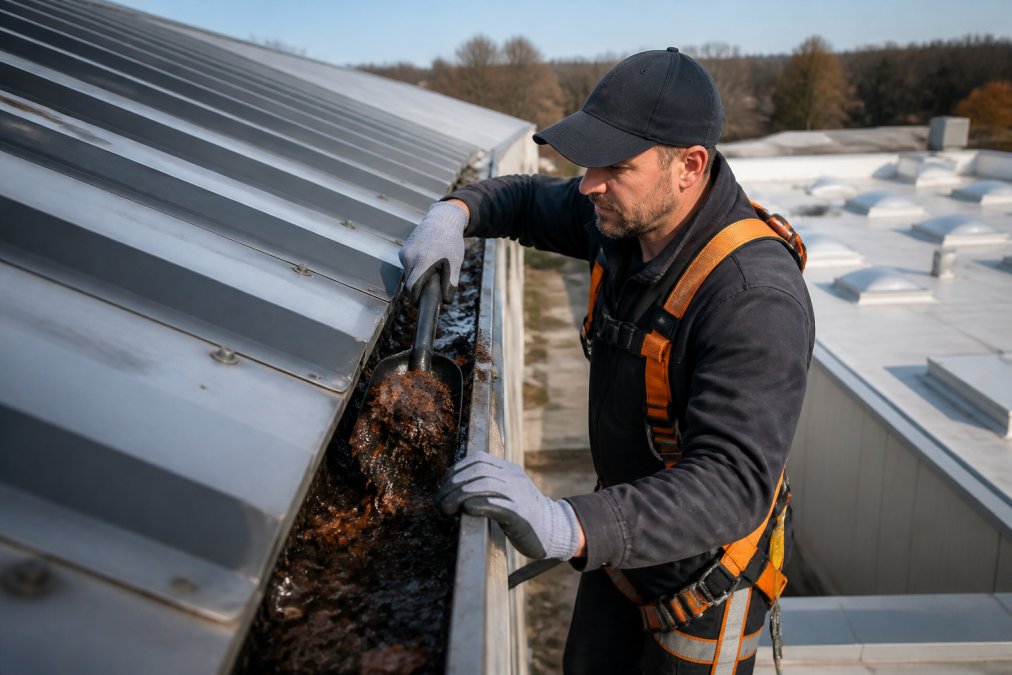
Step 1: Inspect the Area and Set Up Safe Access
Begin by walking the perimeter to identify the lowest points, downspout locations, and any visible sagging. Survey the ground for overhead power lines and confirm the ground surface is level and firm before positioning any ladder or lift. Set up your access equipment on stable ground, and if using a ladder, have a second person on site to stabilize the base and hand tools up.
Step 2: Remove Debris and Flush the Downspouts
Starting at the end farthest from the downspout, scoop debris into your bucket, working in manageable sections. Do not push debris toward the downspout opening, as this creates a plug. After the bulk material is removed, use the brush to loosen the fine sediment film along the gutter bottom. Flush each downspout with the hose to verify water exits freely at ground level, which confirms the vertical run is clear.
Step 3: Check for Damage and Water Flow Issues
With the gutters empty, look for rust spots, separated seams, loose fasteners, and areas where water pools instead of flowing toward the downspout. Check the gutter pitch with a level; water should visibly move toward the outlet. Also inspect the roof edge for signs of rot or staining that indicates previous overflow. Document any issues you find with photos so you can track repairs or share them with a professional.
Common Mistakes to Avoid When Cleaning Commercial Gutters
The most frequent error is neglecting downspout cleaning while focusing only on the horizontal run. A gutter can be spotless, but if the downspout is clogged at the elbow or the underground drain, water will still overflow during the next storm.
Another costly mistake is using a metal shovel or sharp tool that scratches the gutter’s protective coating. Scratches accelerate rust and shorten the system’s lifespan. Avoid leaning a ladder directly against the gutter edge, which bends the metal and destroys the proper pitch. Finally, do not blow debris onto the roof or into the yard where it can wash back into the system; collect everything and dispose of it properly.
When to Call a Professional Gutter Cleaning Service
If the building is taller than a single story, the roof pitch is steep, or you simply lack the time and equipment for safe access, hiring a professional is the smart choice. Commercial gutter cleaning near me searches often return general handymen, but roofing and exterior specialists bring the right safety gear and know how to spot structural issues that lead to premature gutter failure.
For property owners across Liberty Twp and the wider Ohio region, DGK Home Solutions brings over 20 years of experience to commercial roofing, siding, and gutter services. Our teams handle projects of any size with prompt communication and an honest assessment of what your property actually needs, so you avoid surprise costs down the line. We manage the full scope, from clearing the clog to repairing the damage that caused it, and we back the work with top-quality materials and clear follow-through.
Frequently Asked Questions
How often should commercial roof gutters be cleaned?
Inspect commercial gutters at least twice a year, typically in spring and fall. Properties surrounded by heavy tree cover may need quarterly cleanings. After major storms, check gutters for sudden clogs or damage. Regular cleaning at these intervals prevents water damage to the roof structure, foundation, and interior. Consistent maintenance also keeps warranty coverage valid and avoids costly emergency repairs.
What are the OSHA safety requirements for cleaning commercial gutters?
OSHA requires fall protection for work at heights of 4 feet in general industry and 6 feet in construction. Ladders must be inspected and placed on stable ground, extending 3 feet above the roofline. Workers need proper training on hazard recognition and safe equipment use. For most commercial buildings, a personal fall arrest system, guardrails, or a lift is necessary to comply with OSHA gutter cleaning safety standards.
What tools are needed for cleaning large-scale commercial roof gutters?
Essential tools include a sturdy ladder or aerial lift, heavy-duty work gloves, a gutter scoop or trowel, a leaf blower with gutter attachment, and a garden hose with a high-pressure nozzle. A wet/dry vacuum handles fine debris, while a plumber’s snake clears stubborn downspout clogs. For large buildings, a telescoping pole with a curved attachment lets crews work from the ground safely.
How do clogged gutters affect commercial roof warranties?
Most commercial roof warranties require regular gutter maintenance as a condition of coverage. When clogged gutters cause standing water or ice dams that damage the roofing membrane, manufacturers often deny warranty claims because the damage resulted from neglect, not a material defect. Document each cleaning with photos and invoices. This record proves proper maintenance and protects your claim if roof damage later occurs.
Keeping commercial gutters flowing is a year-round responsibility, but the process itself is straightforward when you have the right plan, tools, and safety protocols in place. Whether you handle the cleaning in-house or bring in a specialist, regular maintenance protects the roof investment and prevents costly interior damage. Get started with DGK Home Solutions and request your free quote for professional gutter service that keeps your commercial property protected in every season.
This article was written using GrandRanker