Table of Contents
- How to Find Local Roof Repair Contractors in Your Area
- What to Look for in a Licensed and Insured Roof Repair Contractor
- Evaluating Roofing Company Reviews and Customer Feedback
- Understanding Roof Repair Cost and Getting Accurate Estimates
- How to Avoid Roofing Scams and Contractor Red Flags
- Essential Questions to Ask Before Hiring a Local Roof Repair Contractor
- Post-Repair Inspection Guide and Next Steps
- Conclusion
Last Updated: July 19, 2026
When you need to hire a local roof repair contractor, the stakes are high. Your roof protects everything beneath it, your family, belongings, and home’s structural integrity. Choosing the wrong contractor can cost thousands in wasted money or repairs that fail within months. The right contractor transforms a stressful process into a straightforward one.
This guide walks you through how to hire a local roof repair contractor with confidence. We’ll show you how to find qualified candidates, evaluate credentials, spot red flags, and ask the questions that separate professionals from amateurs.
How to Find Local Roof Repair Contractors in Your Area
Start with a Google search for "roof repair contractors near me" or "[your city] roofing contractors." Google Maps will surface local businesses with ratings, reviews, and verified contact information.
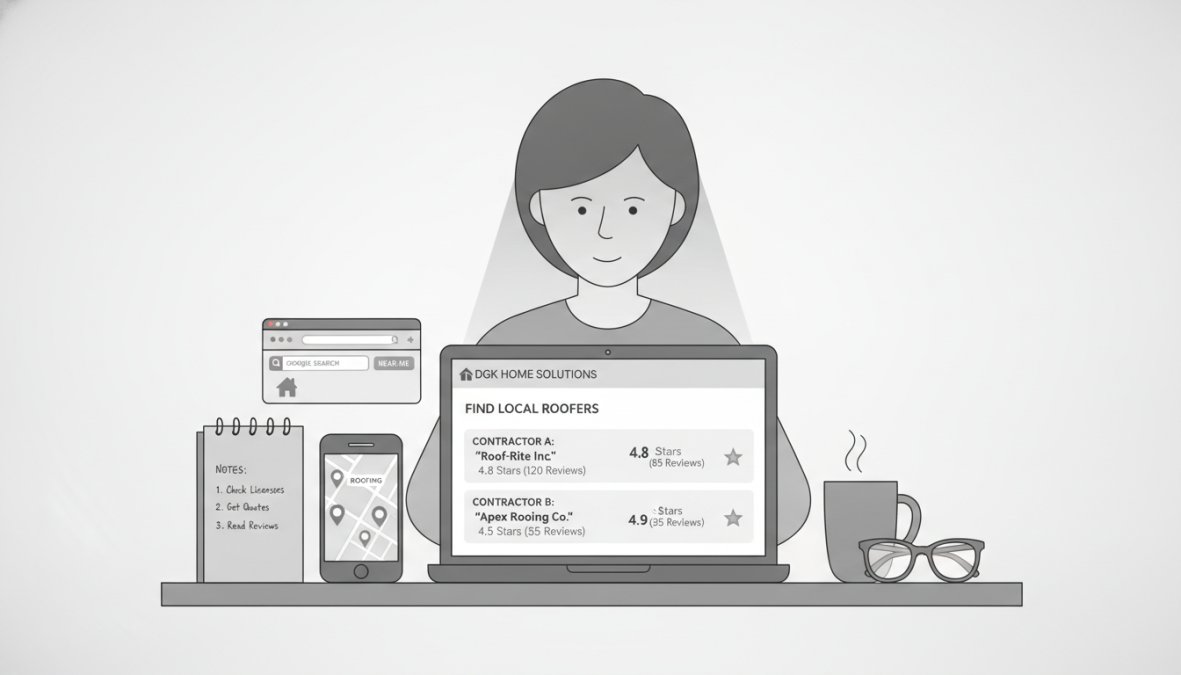
Next, check the National Roofing Contractors Association (NRCA) directory at NRCA contractor finder. Members have met professional standards and continuing education requirements.
Ask for referrals from your insurance agent, real estate agent, or neighbors who’ve had recent roof work. Personal recommendations carry weight because they come with real experience. Local Facebook groups and Nextdoor also provide honest community reviews.
Visit the Better Business Bureau (BBB) at BBB directory and search for roofing contractors in your area. Look at accreditation status and complaint history. Pay attention to how contractors respond to complaints, professionals take criticism seriously.
Google Reviews and Yelp provide volume and specificity. Read the reviews themselves, not just ratings. Look for patterns: Do customers mention professionalism? Did work stay on budget? Was communication clear?
What to Look for in a Licensed and Insured Roof Repair Contractor
A licensed roof repair contractor has passed exams and met your state’s requirements. Before you call anyone, verify the contractor holds an active license through your state’s licensing board.
Look for manufacturer certifications like GAF Master Elite or CertainTeed preferred contractor status. These certifications show the contractor invests in training and stays current with material innovations.
A roofing contractor must carry general liability insurance and workers’ compensation coverage. Liability insurance protects you if someone is injured on your property or if the contractor damages your home. Workers’ compensation protects their employees; if a contractor doesn’t carry it, you could be liable if a worker is injured.
Ask for proof of insurance before work begins. Request certificates showing coverage amounts. Typical general liability coverage is $1 million per occurrence. Verify the information independently by calling the insurance company listed on the certificate.
Bonding is a financial guarantee. If a contractor fails to complete work or doesn’t pay suppliers, the bond covers losses. Check your state’s requirements and ask contractors whether they’re bonded.
| Credential Type | What It Means | Why It Matters |
|---|---|---|
| State License | Contractor passed exams and met state requirements | Ensures baseline competency and legal standing |
| Manufacturer Certification (GAF, CertainTeed) | Specialized training with specific roofing materials | Shows commitment to quality and current practices |
| General Liability Insurance | Coverage if someone is injured or property is damaged | Protects you from being sued directly |
| Workers’ Compensation Insurance | Coverage for contractor’s employees if injured | Prevents you from becoming liable for workplace injuries |
| Bonding | Financial guarantee contractor will complete work | Protects you if contractor abandons the job |
Evaluating Roofing Company Reviews and Customer Feedback
Google Reviews are usually genuine; dissatisfied customers are motivated to leave negative reviews, and Google has systems to catch fake ones. Look at the distribution: a contractor with 47 five-star reviews and three one-star reviews is more credible than one with only perfect reviews.
BBB and Yelp reviews tend to be detailed. Read several to spot patterns. If three customers mention the contractor was late and didn’t communicate, that’s a pattern worth noting.
Facebook and Nextdoor reviews are valuable because they’re from your actual community. A review from a neighbor carries more weight than an anonymous comment.
Watch for reviews that sound scripted or generic. Authentic reviews are specific: "Jared and his crew explained every step, cleaned up daily, finished on time, and the roof looks perfect." That specificity signals a real customer.
Be skeptical of contractors with only perfect reviews. Every contractor has some unhappy customers. A contractor with 100 five-star reviews and zero negative reviews is suspicious.
If a contractor has multiple complaints about the same issue, hidden costs, missed deadlines, poor communication, that’s a pattern, not an exception. Move on to another contractor.
Understanding Roof Repair Cost and Getting Accurate Estimates
Square footage of the roof is the primary cost driver. Pitch matters too; a steep roof is harder and more dangerous to work on, so labor costs increase. Material type affects cost: asphalt shingles are most affordable; metal roofing and slate are premium.
The extent of damage determines scope. A small leak repair might cost a few hundred dollars. A major repair involving structural damage or extensive shingle replacement could cost thousands. Local labor costs also vary; contractors in urban areas charge more than those in rural areas.
Get at least three estimates from different contractors. This gives you a range and helps you spot outliers. Make sure estimates are detailed, listing specific work, materials, labor, timeline, and warranty. Vague estimates don’t tell you what you’re paying for.
Ask whether the estimate is binding or an approximation. Some contractors give a range pending inspection; others guarantee a fixed price.
Request estimates in writing. This creates accountability and gives you something to reference if disputes arise later.
How to Avoid Roofing Scams and Contractor Red Flags
Storm chasers show up after hail or wind damage, offering to file insurance claims and handle everything. They pressure you to sign paperwork immediately, a setup for inflated invoicing.
Cash-only contractors avoid invoices and receipts, claiming to give you a discount. They’re actually avoiding taxes and leaving you with no documentation if something goes wrong.
Bait-and-switch pricing starts with a low estimate, then the contractor "discovers" additional problems during work and charges extra. Legitimate contractors identify major issues during the initial inspection and include them in the original estimate.
Unlicensed contractors save on licensing and insurance costs by operating without proper credentials. If something goes wrong, you’re liable.
Contractor Red Flags Checklist
- No physical address or business location, only a cell phone number
- Unwilling to provide proof of insurance or bonding
- No references or refuses to provide customer contact information
- Pressures you to sign contracts immediately or decide within 24 hours
- Quotes significantly lower than other contractors without explanation
- Demands full payment upfront before starting work
- No written estimate or contract
- Operates primarily in cash and discourages checks or invoices
- No state roofing license or license cannot be verified online
- Negative BBB complaints about the same issue
- Claims to have "leftover materials" from another job and can give you a discount
- Discourages you from getting multiple quotes
If a contractor checks multiple boxes, don’t hire them.
Essential Questions to Ask Before Hiring a Local Roof Repair Contractor
Ask how long the work will take. A straightforward repair might take one to three days; a full replacement takes longer. Ask what happens if weather delays the project. Rain, snow, or high winds can halt roofing work. Does the contractor build buffer time into the schedule?
Ask what warranty they offer on their work. Most contractors warranty labor for one to five years. Manufacturer warranties on materials are separate, typically covering 20 to 50 years. Understand both and what they cover.
Ask who you contact if a problem arises after completion. Will the original contractor return, or do you call a general customer service number? How quickly do they respond to warranty claims?
If your repair is storm-related, ask whether the contractor helps with insurance claims. Some contractors have experience working with adjusters and can advocate for you. Ask how they handle the insurance process and whether they communicate directly with your insurance company.
The best contractors make the insurance claim process transparent and stress-free. They don’t promise to “handle everything” or pressure you to sign paperwork immediately. They explain the process and set realistic expectations.
Post-Repair Inspection Guide and Next Steps
Walk the perimeter of your roof from the ground with binoculars. Look for straight lines of shingles without gaps or overlaps. Check that flashing around vents, chimneys, and edges is sealed and caulked.
Inspect the attic or crawl space for leaks or water stains. Turn off lights and look for daylight coming through the roof. Check for damp insulation or staining on rafters.
Check gutters and downspouts for debris and damage. Gutters should slope toward downspouts so water drains properly. Look at the roof surface for loose shingles, exposed nails, or gaps.
Ask the contractor for a detailed invoice showing work completed, materials used, and labor. Request warranty documentation in writing specifying what’s covered, how long coverage lasts, and how to file a claim.
Take photos of the completed work from multiple angles. These document the condition at completion and are essential if a leak develops later. Keep all correspondence with the contractor, emails, texts, quotes, and invoices, to create a paper trail that protects you if disputes arise.
Choosing the right contractor to hire for a local roof repair can be the difference between a smooth repair and a months-long nightmare. The process requires research, skepticism, and clear communication, but it’s worth the effort. DGK Home Solutions brings over 20 years of experience helping homeowners navigate this decision. We provide transparent estimates, carry full insurance and bonding, and guide you through insurance claims with clear communication every step of the way. When you’re ready to move forward, get a free quote from DGK Home Solutions and see how a professional approach transforms your roof repair experience.
Frequently Asked Questions
What should I look for when hiring a local roof repair contractor?
When hiring a local roof repair contractor, verify they are licensed and insured, check customer reviews and references, confirm their experience with your specific roofing material, and request a detailed written estimate. Ask about warranty coverage, project timeline, and whether they assist with insurance claims. Ensure they provide clear communication and can explain their assessment of your roof's condition in understandable terms.
How do I avoid roofing scams when hiring locally?
Avoid roofing scams by never paying full payment upfront, getting multiple quotes to compare pricing, verifying licensing and insurance credentials directly with your state, and avoiding contractors who pressure you into immediate decisions. Be wary of door-to-door solicitors, overly low bids, and those unwilling to provide references. Always request detailed written estimates and contracts before work begins.
Why is it important to hire a licensed and insured roof repair contractor?
A licensed and insured roof repair contractor demonstrates professional credentials, understands local building codes, and carries liability insurance that protects you if accidents occur. Insurance coverage ensures you're not liable for worker injuries on your property. Licensed contractors are held accountable to industry standards and local regulations, reducing the risk of poor workmanship or abandoned projects.
How much should I expect to pay for roof repair, and what factors affect pricing?
Roof repair cost depends on damage severity, roof size, material type, accessibility, and local labor rates. Factors like emergency repairs, specialized materials, and structural damage can increase costs. Rather than guessing at pricing, request free estimates from multiple local contractors who can assess your specific situation. Comparing detailed quotes helps you understand what different contractors include in their pricing.
This article was written using GrandRanker