Table of Contents
- Why Gutter Pitch Matters for Your Home
- Signs of Improper Gutter Slope and Common Problems
- How to Measure Gutter Pitch and Slope Calculation
- How to Fix Sagging Gutters and Adjust Slope
- Gutter Installation Slope: Getting It Right From the Start
- Common Causes of Gutter Sag and Misalignment
- DIY vs. Professional Repair: Cost-Benefit Analysis
- Preventing Future Gutter Pitch Problems
Gutter Pitch Problems and Solutions: A DIY Guide
Last Updated: July 31, 2026
Gutter pitch problems are critical concerns for homeowners protecting their properties from water damage. When gutters don’t slope properly, water pools instead of flowing toward downspouts, leading to foundation issues, wood rot, and expensive repairs. At DGK Home Solutions, we’ve helped hundreds of Greater Cincinnati-area homeowners identify and fix these problems before they escalate into costly structural damage. Below, we’ll show you exactly how to measure, diagnose, and correct gutter slope issues, whether you’re a confident DIYer or deciding when to call a professional.
Why Gutter Pitch Matters for Your Home
Proper gutter pitch is the foundation of functional drainage. When gutters slope correctly toward downspouts, rainwater moves efficiently off your roof and away from your home’s foundation. When pitch fails, water sits, pools, and eventually finds its way into your walls, basement, or crawl space.
Standing water in gutters becomes a breeding ground for mosquitoes and other pests. Over time, pooled water corrodes metal gutters, creating pinhole leaks that weep water directly onto your fascia board and soffits. In Ohio’s freeze-thaw cycles, standing water expands when frozen, warping hangers and brackets and creating gaps where water escapes.
EXTERNAL_LINK: National Association of Home Builders guidelines on [gutter installation | nahb.org]
The 1/4 inch per 10 feet rule explained
The standard for proper gutter pitch is straightforward: gutters should slope downward at a rate of 1/4 inch for every 10 feet of horizontal run. A 40-foot gutter run should drop 1 inch in total elevation from the high end to the downspout. This ratio balances two competing needs: water must move fast enough to prevent pooling, but not so fast that it overshoots your drainage system. The 1/4 inch per 10 feet rule applies regardless of gutter material, aluminum, copper, steel, or vinyl.
How improper gutter slope leads to water damage
When gutter pitch is inadequate, water accumulates rather than drains. Standing water accelerates corrosion: aluminum gutters oxidize faster, copper develops patina more aggressively, and steel rusts from the inside out. Pinhole leaks develop within 2-3 years in standing water sections.
Water that doesn’t drain eventually overflows. When gutters fill faster than water can exit through downspouts, water spills over the edge and runs down your fascia board, soaks into your soffit, and drips directly onto your foundation. Improper slope also creates ice dams in winter, forcing water to back up under your roof shingles, one of the most expensive gutter-related failures because water intrusion leads to attic rot and interior ceiling leaks.
Signs of Improper Gutter Slope and Common Problems
Diagnosing gutter pitch problems doesn’t require professional equipment. Most signs are visible from the ground or a safe ladder position.
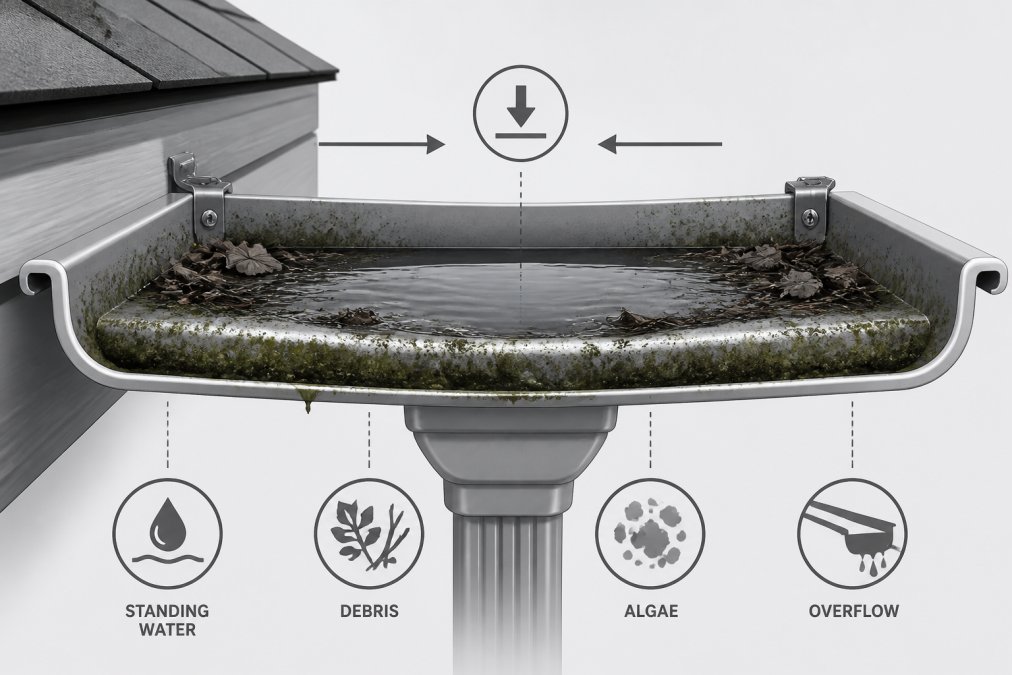
Visual diagnostic checklist for sagging gutters
Standing water in the gutter. After a rain, water should drain completely within 30 minutes. If you see water pooling in the middle of a gutter section hours after rain stops, your pitch is inadequate.
Sagging or visibly dipped sections. Gutters should form a straight, continuous line along your roofline. If you notice a section that dips lower than adjacent sections, the gutter hanger has failed or the fascia board has settled.
Separated or gapped joints. When gutters lose pitch and shift, seams between sections separate. You might see daylight between gutter sections or notice water dripping from a joint during rain.
Visible mineral deposits or algae streaks. White, chalky deposits or green algae growth indicates water sitting long enough for minerals to precipitate or algae to establish.
Downspout positioned off-center or too high. If your downspout sits noticeably higher than the gutter section feeding into it, water can’t flow into the downspout efficiently.
Gutter spikes or ferrules pulling loose. If you see spikes backing out of fascia boards or ferrules spinning freely, the gutter is moving and pitch is being lost.
Standing water, corrosion, and overflow issues
Standing water in gutters creates three distinct problems that compound over time. Metal gutters sitting in water corrode at 5-10 times the rate of gutters that drain properly. Pinhole leaks develop within 2-3 years, causing water to weep directly onto your fascia board and soffit, causing wood rot. A gutter that’s 50% full of standing water has only half its capacity available for new rainfall. During a heavy downpour, that gutter fills completely and overflows. Standing water also attracts mosquitoes and creates conditions for mold and mildew to colonize your gutter interior.
How to Measure Gutter Pitch and Slope Calculation
Measuring gutter pitch is straightforward and requires only basic tools. The goal is to determine whether your current pitch matches the 1/4 inch per 10 feet standard.
Tools needed for accurate measurement
You’ll need a 4-foot or 6-foot level, a 25-foot measuring tape, a pencil or marker, and optionally a gutter pitch gauge or smartphone level app.
Step-by-step measurement process
Step 1: Identify your gutter run. A gutter run is the continuous section from one end to a downspout. Measure each run separately because pitch can vary between runs.
Step 2: Measure the horizontal distance. Using your tape, measure along the roofline from the highest point of the gutter run to the downspout. If your run is 32 feet, you’ll need to establish a 0.8-inch drop (32 feet ÷ 10 = 3.2, then 3.2 × 1/4 inch = 0.8 inch).
Step 3: Place your level on the gutter. Position the level so it rests on the bottom of the gutter, running parallel to the direction of water flow toward the downspout.
Step 4: Measure the vertical gap. At the downspout end, place a shim or spacer under the level until the bubble centers. Measure the thickness of the shim. This is your actual pitch.
Step 5: Record and assess. If your actual pitch is within 1/8 inch of the target, your gutter is functioning acceptably. If it’s 1/4 inch or more below target, you have a pitch problem that needs correction.
Use a smartphone level app for a quick reality check. A proper gutter pitch reads between 1.4 and 2.4 degrees depending on your measuring method. If your phone reads 0 degrees (level) or negative degrees (reversed slope), your pitch has failed.
How to Fix Sagging Gutters and Adjust Slope
Once you’ve identified a pitch problem, your next decision is whether to adjust existing gutters or replace them. This depends on the severity of the sag, the age of the gutters, and the underlying cause.
Assessing whether to repair or replace
Repair is viable when: the gutter material is still sound, the sag is localized to one or two sections, the fascia board is straight and solid, gutters are less than 15 years old, and the problem is caused by loose or failed hangers.
Replace when: corrosion has created holes or pinhole leaks, multiple sections are sagging or separated, the fascia board is rotted or warping, gutters are 20+ years old, or the pitch problem is caused by ongoing foundation movement.
For most homeowners in the Greater Cincinnati area, a localized pitch problem caused by loose gutter brackets is repairable. If the sag is widespread or the fascia board is compromised, replacement is more cost-effective.
Do not attempt to fix gutter pitch problems while standing on a ladder without a safety harness or spotter. Falls from 10-15 feet cause serious injury. If you’re uncomfortable working at height, call a professional like DGK Home Solutions, who has the equipment and insurance to work safely on your roof line.
Adjusting gutter brackets and hangers for proper alignment
If your pitch problem is caused by loose or failed gutter brackets, tightening or replacing them can restore slope without replacing the entire gutter system.
Step 1: Locate all gutter hangers in the problem section. Gutter hangers are typically spaced 24-32 inches apart.
Step 2: Inspect each hanger for damage. Look for spikes backing out, ferrules spinning freely, or visible corrosion. Corroded or damaged hangers should be replaced.
Step 3: Tighten loose fasteners. If a spike is backing out, tap it back in using a hammer. If a screw is loose, tighten it with a screwdriver.
Step 4: Adjust hanger position if needed. For some hangers, you can loosen the fastener, shift the hanger up or down slightly to adjust pitch, and re-tighten.
Step 5: Replace failed hangers. If a hanger is corroded, cracked, or damaged, remove the fastener completely and install a new hanger of the same type. Use stainless steel or galvanized fasteners to prevent future corrosion.
Gutter hanger installation standards from the Metal Gutter Contractors Association
Step 6: Re-measure pitch after adjustment. Once you’ve tightened or replaced hangers, re-measure the gutter pitch using the method described above to confirm you’ve achieved the target 1/4 inch per 10 feet slope.
Gutter Installation Slope: Getting It Right From the Start
If you’re installing new gutters or replacing failed sections, establishing proper pitch during installation prevents problems years down the road. The slope must be built in from the start; you can’t easily correct pitch after installation.
How roof pitch affects gutter slope requirements
Your home’s roof pitch influences gutter slope requirements. A steep roof (8:12 pitch or steeper) sheds water much faster than a low-pitch roof (4:12 or less). On a steep roof, water enters gutters with significant velocity, and you must ensure downspout capacity matches the water volume. A steep roof might require larger-diameter downspouts (4 inches instead of 3 inches) or additional downspouts. The 1/4 inch per 10 feet standard remains appropriate for all roof pitches.
Mounting hardware and fastening for stable installation
Gutter installation begins with selecting the right mounting hardware for your fascia board condition and roof structure. Hidden hangers mount inside the gutter, hidden from view, and are the modern standard. Exposed hangers (including spike-and-ferrule systems) mount on the outside of the gutter and are simpler to install and adjust.
For new installations, use stainless steel fasteners or hot-dipped galvanized fasteners. Avoid plain steel or aluminum fasteners, which corrode quickly and fail within 5-10 years.
Installation sequence:
- Snap a chalk line on the fascia board marking your target pitch (1/4 inch drop per 10 feet)
- Install the first hanger at the high point of the run
- Install subsequent hangers along the chalk line, spacing them 24-32 inches apart
- Ensure each hanger is tight before moving to the next one
- After all hangers are installed, place the gutter in the hangers and verify pitch with a level
Proper pitch during installation is infinitely easier than trying to correct pitch problems after gutters are installed and water damage has begun. Invest the time to get it right the first time.
Common Causes of Gutter Sag and Misalignment
Understanding why gutters sag helps you prevent the problem and recognize when professional intervention is necessary.
Age, debris load, and weather damage
Gutters deteriorate through predictable stages. Debris accumulation is the primary culprit. Leaves, pine needles, shingle granules, and sediment collect in gutters. A full gutter can weigh 50-100 pounds more than an empty one. Over time, this constant weight stresses hangers and fasteners. Spikes back out. Fasteners loosen. The gutter sags under the load.
Weather cycles accelerate failure. Ohio’s freeze-thaw cycles are particularly hard on gutters. Water freezes in gutters, expanding and warping the metal or vinyl. UV exposure degrades materials. Vinyl gutters become brittle in sunlight. After 15-20 years of sun exposure, materials lose their structural integrity. Storm damage can cause immediate sag from heavy snow, ice loads, falling branches, or wind-driven debris.
Foundation settling and fascia board issues
Gutter sag sometimes reflects larger structural problems with your home. Foundation settling is common in older homes. As soil beneath your foundation shifts, the entire structure settles unevenly, causing the fascia board to shift out of plumb. Gutters attached to a settling fascia board lose pitch and sag.
Fascia board rot undermines gutter support. If the fascia board is rotted or water-damaged, fasteners don’t hold securely. Spikes and screws pull loose because the wood beneath them is soft and decayed. In Greater Cincinnati’s older neighborhoods, many homes have fascia boards that are 30-50 years old. If your gutters are sagging, have the fascia board inspected.
DIY vs. Professional Repair: Cost-Benefit Analysis
Deciding whether to tackle gutter pitch problems yourself or hire a professional depends on your comfort level, the complexity of the problem, and safety considerations.
| Factor | DIY | Professional |
|---|---|---|
| Cost | $100-400 for materials | $400-1,200+ depending on scope |
| Time investment | 4-8 hours for most jobs | 1-2 days, less disruption |
| Safety risk | High (ladder work at height) | Minimal (proper equipment & insurance) |
| Precision | Moderate (easy to miss slight pitch errors) | High (guaranteed proper slope) |
| Warranty | None | Typically 5-10 years |
| Best for | Loose hangers, minor adjustments | Fascia replacement, full gutter replacement |
When to call a professional gutter specialist
Call a professional if the fascia board is rotted or warped, multiple gutter sections are sagging, you’re uncomfortable working at height, your home is over 40 years old, or you need a warranty on the work.
At DGK Home Solutions, we handle gutter pitch problems as part of comprehensive roof and exterior assessments. Our team in Liberty Township and Greater Cincinnati evaluates your entire drainage system, roof pitch, gutter slope, downspout placement, and foundation grading, to ensure water flows away from your home properly. We provide honest assessments of whether repair or replacement is appropriate and guarantee our work.
Safety considerations for DIY gutter work
If you decide to tackle gutter pitch adjustment yourself, safety must be your priority. Use a 24-foot extension ladder or taller for most residential gutters. Ensure the ladder is on level ground with proper angle (1 foot out for every 4 feet up). Have someone spot you and hold the ladder. Never lean more than 12 inches to either side. If you’re working above 6 feet, use a safety harness anchored to the roof. Work on gutters on a clear, dry day and wear work gloves to protect your hands.
Preventing Future Gutter Pitch Problems
Once you’ve corrected gutter pitch problems, preventive maintenance keeps them from recurring.
Regular maintenance and drainage inspection
Clean gutters twice yearly. Spring and fall cleaning removes leaves and debris that accumulate and add weight. A clogged gutter can’t drain properly even if pitch is correct.
Inspect after storms. Heavy rain, snow, or wind can shift gutters or knock hangers loose.
Monitor downspout function. Ensure downspouts are clear and water flows out freely. A clogged downspout forces water to back up into the gutter, creating standing water even if pitch is correct.
Check for separated seams. If you notice water dripping from a seam during rain, the connection is failing and needs resealing or replacement.
Trim overhanging branches. Tree branches above your gutters drop leaves and debris directly into them. Trimming branches reduces debris load and prevents branch damage during storms.
Protecting your foundation and home structure
Proper gutter pitch protects your foundation and home structure by directing water away from your home. Extend downspouts 4-6 feet from the foundation. Water exiting downspouts should land on ground sloped away from your home.
Grade your landscape away from the foundation. The ground should slope downward as you move away from your home. This ensures water from gutters and roof runoff flows away rather than pooling against your foundation.
Install or maintain foundation drainage. If your home has a basement or crawl space, ensure foundation drainage systems are clear and functioning.
Monitor for foundation cracks or settling. If you notice new cracks in your foundation, basement walls, or exterior walls, this can indicate foundation settling, which changes gutter pitch and requires professional assessment.
Gutter pitch problems are preventable with regular maintenance and prompt attention to early warning signs. Standing water, sagging sections, and separated seams are all signals that your drainage system needs adjustment. For homeowners in Liberty Township and the Greater Cincinnati area facing complex gutter pitch issues, foundation concerns, or widespread damage, professional assessment saves time and prevents costly mistakes. DGK Home Solutions brings over 20 years of experience diagnosing and correcting gutter problems as part of comprehensive exterior and roofing solutions. Our team provides honest assessments of whether repair or replacement is appropriate, clear communication throughout the process, and workmanship backed by warranty. Contact DGK Home Solutions for a free quote and expert evaluation of your gutter system.
Frequently Asked Questions
What is the correct pitch for gutters?
Proper gutter pitch should slope at approximately 1/4 inch per 10 feet of gutter run toward the downspout. This slight incline ensures water flows efficiently away from your roof and home foundation. The slope must be consistent along the entire gutter run to prevent standing water and pooling, which can lead to corrosion, overflow, and foundation damage.
How do you tell if your gutters have improper gutter slope?
Signs of improper gutter slope include standing water or pooling in gutter sections, visible sagging or misalignment, water overflowing during rainfall, algae and moss growth, and rust or corrosion spots. A visual inspection from the ground can reveal obvious sags. Use a leveling tool or chalk line to confirm the slope angle. If water doesn't drain toward the downspout within 24 hours after rain, your slope likely needs adjustment.
Can you adjust existing gutter pitch?
Yes, existing gutter pitch can often be adjusted by repositioning gutter brackets, hangers, and fastening hardware. This works best for minor slope corrections. For significant adjustments, you may need to install gutter wedges or spacers behind the fascia board to support proper alignment. However, if gutters are severely sagging or corroded, replacement may be more cost-effective than repair. A professional assessment can determine whether adjustment or replacement is the best solution.
What causes improper gutter slope and sagging gutters?
Common causes include age-related wear on mounting hardware and fasteners, excessive debris and water weight in the gutter, improper original installation, foundation settling that shifts the fascia board, weather damage from ice dams or heavy snow loads, and corrosion of gutter spikes and ferrules. Uneven roof pitch and canted fascia boards can also contribute to slope problems. Regular gutter maintenance and drainage inspection help prevent these issues from developing.
This article was written using GrandRanker